Sources
A Brief History of Voltage & Thought
The Origins (1897-1930)
The Art of Noise
The new sound generation processes attracted the attention of the Futurist movement which sought to imitate industrial sounds.
“Musical sounds are too limited to qualitative varieties of timbre... We must leave this restricted circle of pure musical sounds and conquer the infinite variety of sounds”— Luigi Russolo (1913)
These proposals were materialized by the construction of noisy instruments: the Intonarumori.
Edgar Varèse
The composer of his time who contributed most to the acceptance of diverse sound sources in musical composition.
"Wherever we are, all we hear is mostly noise... We want to capture and control these sounds, we do not want to use them as studio treatments but as instruments..."
— John Cage, 1937This would be made possible by the technique of Sound Synthesis.
Philosophy of Sound
"Buchla tended to not refer to his instruments as synthesizers, since the name connotes imitating existing sounds. Rather, his intent is to make instruments for creating new sounds, avoiding the use of keys so that the musician isn’t playing traditionally... While Moog was interested in making playable devices for performers in the mainstream."
Defining Modular
Modular Synthesis gives the ability to connect or “patch” modules together in whatever way the composer wants in order to create unique, never-before-heard sounds.
Unlike self-contained gear with hardwired connections, modular offers the ability to expand the system in infinite ways.
Devices are controlled by other devices by means of CV (control voltage), the lifeblood of modular.
"THOUGH one has to bear in mind that Modular Synthesis isn’t about Modules… It’s not about the character of the Module itself BUT bringing together a collection of functions! Knowing how to use/interact them so as to become our own unique instrument."
HISTORICAL SYSTEMS
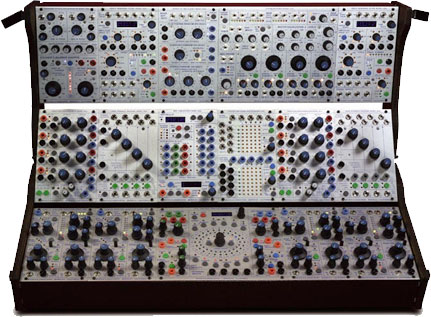
Buchla System 200
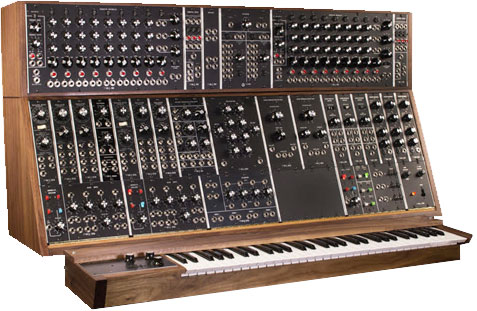
Moog System 35
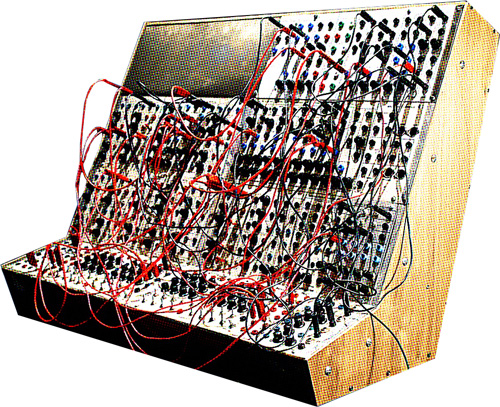
Serge System
Anatomy of a System (1/3)
Case & Power
Euroracks are typically in rows of 3U measured in HP (horizontal pitch). A robust power supply is critical. The investment in a rack is typically one of the largest cash outlays and should not be taken lightly.
Oscillators (VCO)
The sound source. Converts direct current (DC) into an alternating current (AC) signal (sine, square, saw). Voltage Controlled Oscillators allow frequency variation via input voltage.
Anatomy of a System (2/3)
Filters (VCF)
Sculpts the sound timbre. Allows cutoff frequency and resonance (Q factor) to be continuously varied via control voltage. Essential for subtractive synthesis.
Envelopes (EG/ADSR)
Shapes a signal over time (Attack, Decay, Sustain, Release). Controls volume or filter depth to define if a sound is percussive, plucked, or a swelling drone.
Anatomy of a System (3/3)
LFOs
Low-Frequency Oscillation. Below 20Hz, inaudible as pitch but used to create rhythmic pulses, sweeps, vibrato, or tremolo effects.
Amplifiers (VCA)
Voltage Controlled Amplifiers. Controls the amplitude (volume) of a signal based on an external voltage (usually from an Envelope Generator).
Essential Utilities
The glue that holds a patch together:
- → Multiples
- → Mixers
- → Slew Limiters
- → Clock Dividers
- → Attenuverters
- → Random Generators
- → Effect Processors
- → LOADS of cables...
External Knowledge